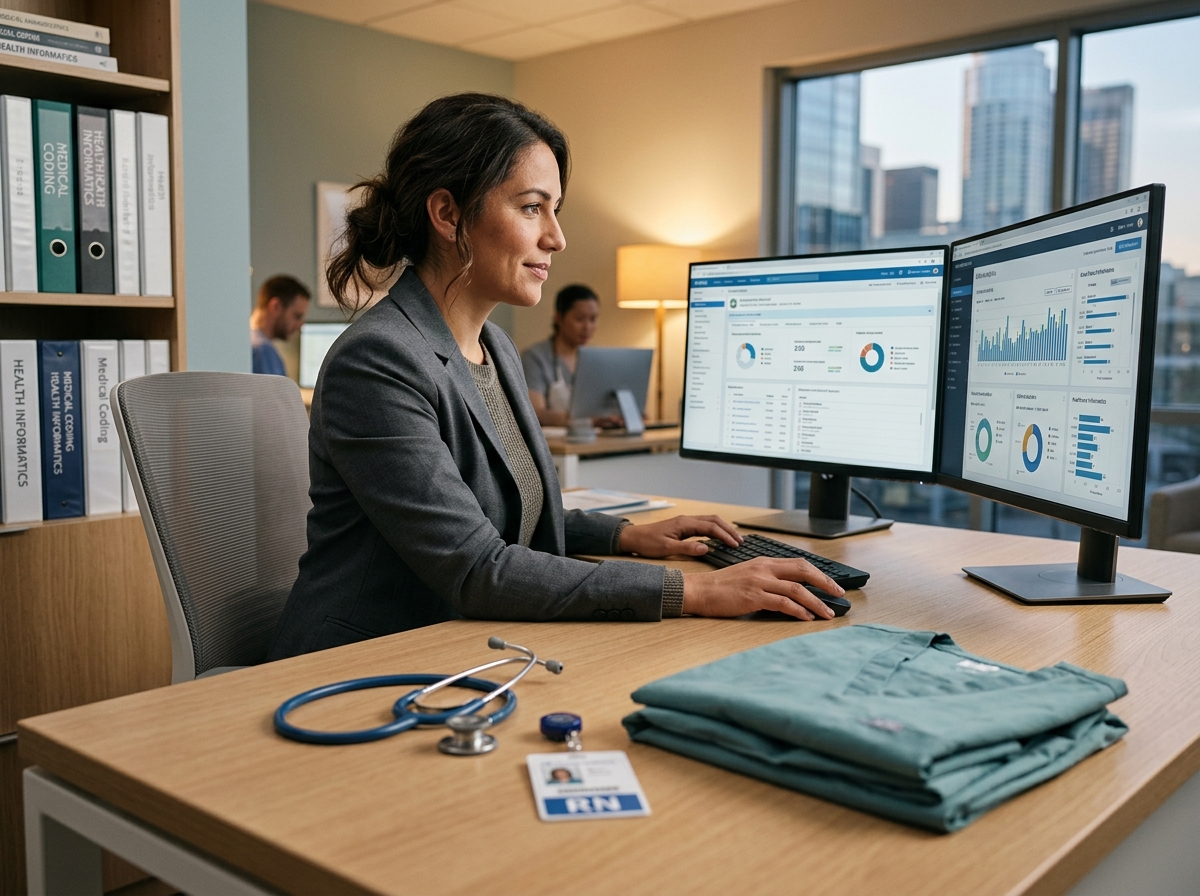
Why nurses pivot to HIM
The reasons are well-documented and consistent across recent nursing workforce surveys. Burnout, moral injury after the pandemic years, physical wear-and-tear from twelve-hour bedside shifts, unpredictable schedules and weekend rotations, mandatory overtime, and the slow drift from direct patient care toward documentation and screen-based charting.
HIM offers a counter-position to most of those stressors. Most CDI, coding, informatics, and HIM management roles are weekday daytime work, often remote, with no physical patient care, no shift work, and no holiday rotations. The trade is real (less direct clinical impact, less collegial bedside team energy) but for nurses who have made the decision to leave bedside care, the HIM destination is one of the cleanest landing spots in healthcare.
Importantly: the clinical content knowledge that nurses already hold is genuinely valuable in HIM. CDI, inpatient coding, and clinical informatics all reward the deep anatomy, pharmacology, lab interpretation, and disease-process understanding that nursing school and bedside experience build. This is why HIM employers actively recruit RNs and why the transition is well-paved.
The CDI path (most common)
Clinical Documentation Improvement is the single most popular nurse-to-HIM transition. Roughly 70% of CDI specialists nationally are RNs or have a nursing background, according to ACDIS workforce surveys.
What CDI specialists do
CDI specialists review inpatient charts concurrently (while the patient is still admitted) and query physicians when documentation is unclear, incomplete, or doesn't support the level of clinical severity present. The output is more accurate, more defensible coded data, which improves DRG assignment, case mix index, severity reporting, and quality measure capture.
What you need
- RN license (typically the only hard requirement at entry)
- 3-5 years bedside clinical experience preferred (ICU, med-surg, or specialty)
- Foundational ICD-10-CM and MS-DRG literacy (often acquired on the job)
- Bootcamp or self-study: ACDIS CDI Boot Camp or AHIMA CDI training (3-6 months part-time)
- CCDS or CDIP credential after 2 years of CDI experience (not required at hire)
Pay at entry and over time
| Stage | Typical pay | Comparison vs RN bedside |
|---|---|---|
| CDI entry (0-1 yr) | $78,000-$95,000 | Often close to or above bedside RN base, without shift differential |
| CDI mid (2-5 yr) | $92,000-$118,000 | Solidly above bedside RN base |
| CDI senior / lead (5+ yr) | $110,000-$140,000 | Above most bedside RN total comp |
| CDI consultant / contract (5+ yr) | $60-$90/hr (~$125,000-$185,000) | Significantly above bedside |
The trade is that you lose shift differential and overtime pay that boost RN total compensation. For nurses doing significant overtime or premium weekend shifts, the headline base may look comparable but the apples-to-apples total comp comparison takes 1-2 years to fully favor CDI. See the CDI salary deep dive for full detail.
The coding path
Medical coding (especially inpatient coding) is a legitimate transition target, but the entry pay step requires honest planning. The clinical background that nurses bring is genuinely valuable for inpatient ICD-10-PCS procedure coding and complex case coding, but employers will not pay an entry-level coder RN-level wages just because of the nursing credential.
What you need
- Coding certificate program (online or community college, 6-12 months, $1,500-$5,000)
- CPC (AAPC) or CCS (AHIMA) certification
- Some employers want CCA first, then CCS within 2 years
- 1-2 years of entry-level outpatient or physician coding work to qualify for inpatient coding
Pay reality
Entry-level coding pays $42,000-$58,000. For an RN coming off a $75,000-$95,000 bedside salary, this is a substantial cut. Most RN-to-coder transitions recover pay parity in 3-5 years through multi-credentialing (CPC + CCS), specialty work (inpatient, surgical, interventional radiology), and/or moving to CDI from coding.
See the medical coder salary deep dive and the medical coder career profile for the full credential progression.
When the coding path makes sense
Nurses who specifically want to do coding (not CDI, not informatics) often have a personal preference for the meticulous, focused, single-task nature of coding work. The transition makes most sense for nurses who are confident the pay step down is acceptable for 2-3 years in exchange for the work itself.
The clinical informatics path
Clinical informatics (also called nursing informatics for RNs who keep the clinical title) is the highest-ceiling transition target. Clinical informaticists, EHR analysts, and informatics specialists work on EHR build, decision support design, clinical workflow optimization, and population health analytics.
What you need
- RN license + 3-5 years bedside experience (employers want clinical credibility)
- Graduate certificate or master's in health informatics or nursing informatics (12-24 months)
- EHR experience as an end-user (Epic, Cerner, Meditech) is highly valued
- Optional: Epic certifications in Clinical Documentation, Inpatient Orders, or ASAP (typically employer-sponsored after hire)
- Optional: ANCC Informatics Nursing certification (RN-BC) after 2 years of informatics work
Pay at entry and over time
| Stage | Typical pay |
|---|---|
| EHR / clinical analyst (entry) | $85,000-$105,000 |
| Clinical informaticist (mid) | $100,000-$130,000 |
| Lead / senior informatics specialist | $125,000-$165,000 |
| Director of clinical informatics / CNIO | $160,000-$245,000+ |
The path has a 12-24 month education investment but generally avoids a pay step down on entry. See the health informatics master's guide and the HIM vs informatics guide for full detail.
The HIM leadership path
A smaller but real path: nurses who target HIM director and executive HIM roles directly, typically via a master's degree (MS HIM or MBA with healthcare focus) and progressive HIM management experience.
What you need
- Bachelor's degree (BSN typically suffices)
- Master's in HIM, health informatics, MHA, or MBA with healthcare focus
- RHIA credential (highly valued for HIM director roles)
- 3-5 years of HIM operations management experience (often acquired via CDI lead or HIM supervisor stepping-stone roles)
Pay outcome
The HIM director path ends at $130,000-$220,000 depending on hospital size and system complexity. National median for Medical and Health Services Managers (SOC 11-9111, which includes HIM directors): $123,860. See the HIM Director salary deep dive for full detail.
This is the slowest path (5-7 years from RN to HIM director) and the most education-intensive, but it has the highest pay ceiling outside of clinical informatics.
Salary reality check
The clean side-by-side, comparing a typical RN with 5 years of bedside experience earning $82,000 base ($95,000 with overtime and differentials) to each transition target at the 1-year mark.
| Transition target | Year-1 pay | Direction vs RN base |
|---|---|---|
| CDI specialist | $85,000-$98,000 | Roughly even (often slightly above base, below total comp) |
| Medical coder (entry) | $45,000-$60,000 | $22,000-$37,000 step down |
| Clinical informaticist / EHR analyst | $90,000-$110,000 | Slightly above |
| HIM supervisor / coding supervisor | $75,000-$95,000 | Roughly even |
The lifetime earnings comparison favors the transition by year 5 across all four paths, but the first 12-24 months are mixed. CDI and clinical informatics are the two paths that generally do not require a financial sacrifice during transition.
Realistic timelines
| Path | Education / prep | Time to first role |
|---|---|---|
| CDI | 3-6 mo bootcamp or self-study | 3-9 mo total |
| Medical coding | 6-12 mo certificate + CPC/CCS | 9-18 mo total |
| Clinical informatics | 12-24 mo graduate cert or master's | 12-30 mo total |
| HIM leadership | 24-36 mo master's + supervisor experience | 5-7 yr total to director |
How to start
- Pick the path honestly. Be clear about what you want from the transition (income protection, intellectual interest, work-life balance, advancement ceiling) and let that drive the choice, not just what's easiest.
- If CDI: start with ACDIS or AHIMA training and apply to "CDI specialist - RN preferred" postings. Many hospitals will hire you directly with bedside experience and pay for training.
- If coding: get the certificate from a CAHIIM-accredited or AHIMA-approved program. Sit for CCA or CPC. Apply to entry-level outpatient coding roles and plan for 2-3 years to multi-credential.
- If informatics: find an EHR analyst role at your current hospital first if possible. Internal moves into informatics are dramatically easier than external entry. Start the graduate certificate or master's while you are still working clinically.
- If leadership: take a CDI or HIM supervisor role first. Build the operational management track record while completing a master's. The senior HIM director path needs both.
- Talk to people doing the role. ACDIS forums, AAPC chapter meetings, HIMSS local chapters, and LinkedIn cold outreach to nurses who have made the transition are all productive.
FAQ
What's the easiest path?
CDI. Clinical content transfers directly, employers actively recruit RNs, and the pay parity is generally achieved at entry. Most other paths require either a temporary pay step down or a significant education investment.
Do I need to give up my RN license?
No, and you should not. Keep the RN license active. Many CDI and clinical informatics roles explicitly require an active RN license. Even if not required, it provides career optionality and is often a credibility marker for clinical-content work.
Can I work remote right away?
Most CDI and coding roles are remote or hybrid. Informatics roles vary; entry analyst roles often hybrid, senior informaticists frequently remote. Some employers require 6-12 months on-site before transitioning to remote.
Is the transition harder for newer nurses?
Yes. CDI and clinical informatics employers strongly prefer 3-5 years of bedside experience. With less than 2 years of nursing experience, coding becomes the most accessible immediate entry path.